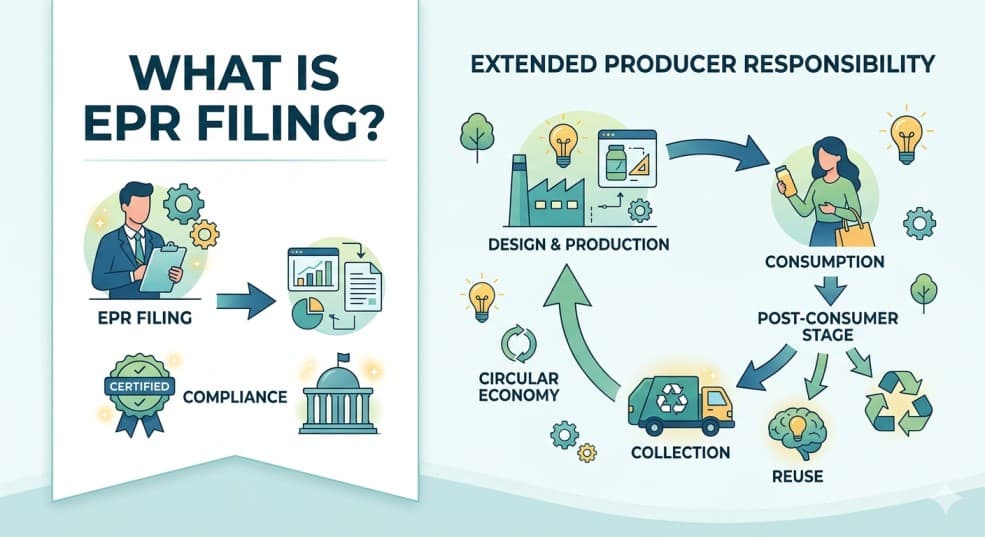
Extended Producer Responsibility (EPR) has evolved from being a recommended sustainability practice to becoming a mandatory environmental compliance framework enforced by the Government of India. Today, it is not something businesses can choose to adopt later—it is an essential regulatory requirement that directly impacts how companies design, produce, and manage their products after consumption.
At its core, EPR places responsibility on producers, importers, and brand owners to manage the waste generated from their products once they reach the end of their life cycle. This includes collection, recycling, treatment, and environmentally safe disposal. The idea is simple but powerful: those who introduce products into the market must also take responsibility for what happens when those products become waste.
An EPR certificate acts as formal proof that a company is complying with these regulations and actively participating in responsible waste management practices. It demonstrates accountability and ensures that the organization is aligned with government-approved environmental guidelines.
With the strengthening of the Plastic Waste Management Rules, especially after the 2022 amendments, India has significantly tightened its focus on reducing plastic pollution and improving recycling systems. These regulations aim to create a more structured waste management ecosystem where recycling becomes a standard practice rather than an afterthought.
Ultimately, EPR is not just a compliance requirement—it is a step toward building a circular economy where materials are reused, recycled, and reintegrated into production cycles instead of being discarded irresponsibly.
Tips to Enhance EPR Sustainability in a Short Time
While EPR compliance may sound complex, improving sustainability under this framework does not always require large-scale transformation. In fact, meaningful progress can be achieved through consistent, well-planned actions that gradually strengthen the system.
One of the most important steps is ensuring that all manufacturers, importers, and brand owners within an organization are properly registered under the EPR framework. Without proper registration and classification, compliance becomes incomplete and ineffective.
Another crucial factor is maintaining a transparent system to track waste generation and its entire journey—from collection to processing and final recycling. When businesses clearly understand how much waste they are generating and how it is being handled, they are better equipped to improve efficiency and reduce environmental impact.
Awareness also plays a key role. Educating consumers, stakeholders, and even internal teams about proper waste segregation and recycling practices helps create a more responsible ecosystem. When people understand the importance of correct disposal, the entire EPR system becomes more effective.
In addition to this, setting long-term sustainability goals is essential. Companies should define clear targets for waste collection, recycling rates, and reduction strategies. These goals not only help measure progress but also encourage continuous improvement in environmental performance.
When implemented collectively, these steps help shift EPR from a regulatory obligation to a structured sustainability practice that supports responsible production and consumption.
Conclusion
EPR is more than just a regulatory requirement—it represents a shift in how businesses perceive responsibility toward the environment. It encourages industries to think beyond production and sales, and instead consider the entire lifecycle of their products.
As awareness around sustainability grows, EPR will continue to play a critical role in shaping cleaner, more responsible industrial practices. Companies that adopt it seriously not only remain compliant but also contribute meaningfully to environmental protection and long-term sustainability.
In the end, EPR is not just about following rules—it is about building a future where growth and environmental responsibility move forward together.