Not every business is responsible for the waste it generates.
But under Extended Producer Responsibility (EPR), Producers, Importers, and Brand Owners (PIBOs) are legally responsible for managing the waste generated by their products.
In 2026, CPCB Certificate Registration is an essential compliance requirement for businesses covered under the applicable EPR regulations across 9 waste categories.
But which category does your business fall under, and how do you get registered?
What is a CPCB certificate, and who needs it?
Central Pollution Control Board (CPCB) is the responsible body that enforces EPR across all waste categories imposed on businesses in India.
By CPCB registration or CPCB certificate it means, enrolling your businesses to show accountability for the waste generated because of their product.
So, who really needs CPCB registration?
Business entities covered under the applicable EPR regulations include:
1. Producers
Businesses involved in manufacturing or placing regulated products and packaging in the market.
- Manufacturers of regulated products.
- Packaging manufacturers.
- Factories producing electrical and electronic equipment.
- Manufacturers of batteries, tyres and other regulated products.
- Contract manufacturers covered under applicable EPR rules.
2. Importers
Businesses importing regulated products or packaging into India.
- Importers of electronic equipment.
- Battery and tyre importers.
- Businesses importing plastic packaging.
- Companies importing products with regulated packaging.
3. Brand Owners
Businesses selling products under their own brand name or trademark.
- FMCG companies.
- E-commerce brands.
- Private label businesses.
- Supermarkets and retail chains.
- Companies outsourcing product manufacturing but selling under their own brand.
4. Recyclers and Waste Processors
Businesses involved in the collection, processing and recycling of regulated waste.
- Plastic waste recyclers.
- E-waste recyclers.
- Battery waste recyclers.
- Tyre recyclers.
- Used oil recyclers.
- Other authorised waste processors covered under applicable rules.
Please note that this is not a complete checklist of who is eligible for the CPCB registration online.
The stakeholders of the nine EPR categories vary based on their respective rules.
Each waste category has its own definitions of PIBOs and other regulated entities. Before applying, assess the entity based on its specific business activity and the waste it generates.
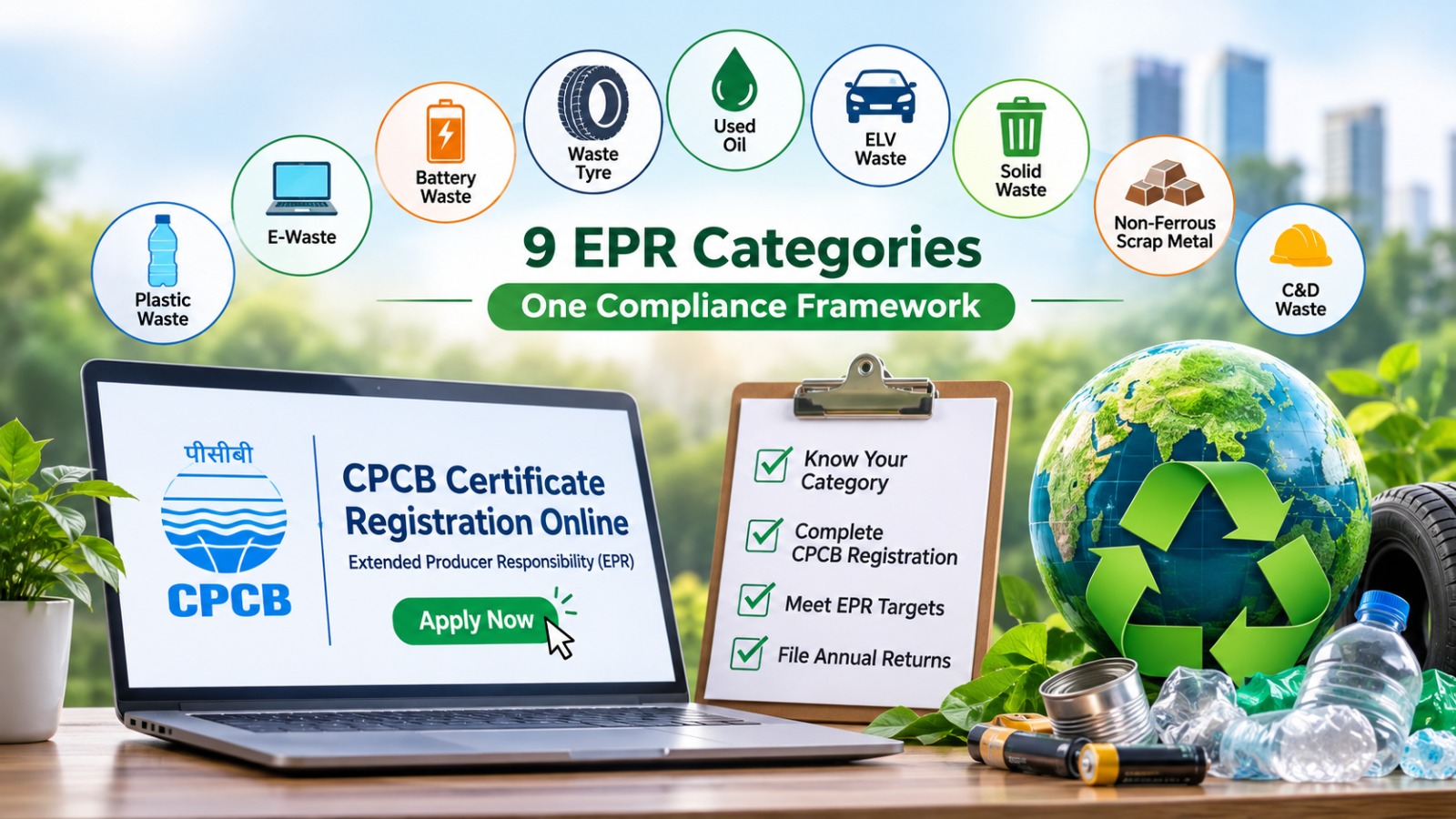
What Are the 9 EPR Categories Covered Under CPCB Compliance?
None of the EPR categories mentioned below is simply a compliance checklist you complete and forget.
In fact, this should be standard business practice where environmental responsibility becomes one of the business priorities and helps build ESG value in the market.
Based on the waste categories mentioned below, these are the most common obligations that you “have” to do, while each waste category has its own requirements:
- Meet the collection and recycling targets based on the waste category before the deadline.
- Partner up with only CPCB-registered collection agents, refurbishers and recyclers
- Collect your respective certificates from the registered recyclers
- Maintain a traceable record of proof for recycling and waste processing
- File annual returns in the CPCB EPR portal
While these are the foundational obligations that the business has to do, they also vary slightly based on the nature of your business and your waste categories.
Here are the waste categories that your business cannot overlook:
Plastic waste EPR
This ongoing compliance framework is focused on the entities whose business operations and the product itself generate plastic pollution.
Here are the four categories that are mandated under the Plastic Waste Management Rules 2016:
- Category I: Rigid Plastic Packaging
- Category II: Flexible Plastic Packaging
- Category III: Multilayered Plastic Packaging (MLP)
- Category IV: Compostable Plastic Packaging
These categories should be assessed carefully and
E-waste EPR
Under the E-Waste (Management) Rules, 2022, producers of electrical and electronic equipment (EEE) are responsible for ensuring that the e-waste generated from their products is recycled through authorised channels. The obligations are even extended to refurbishers and recyclers.
E-waste recycling has become essential to maintain, as they contain vital resources that can be reused in the production cycle, thereby maintaining a circular economy in the supply chain.
3. Battery Waste EPR
As per the Battery Waste Management Rules, 2022, businesses involved in manufacturing, importing, selling or recycling batteries under their brand are responsible for ensuring the environmentally sound management of waste batteries.
Since waste batteries contain valuable materials such as lithium, cobalt, nickel and lead, proper recycling helps recover these resources and reduces the need for fresh raw material extraction.
4. Waste Tyre EPR
Waste Tyre EPR operates under the Hazardous and Other Wastes (Management and Transboundary Movement) Rules, 2016, as amended in 2022. It covers tyre producers, recyclers and retreaders involved in the management of waste tyres.
The framework aims to ensure that discarded tyres are channelled towards authorised recycling and retreading instead of being dumped or disposed of improperly.
5. Used Oil EPR
The Used Oil EPR framework, introduced through the 2023 amendment to the Hazardous and Other Wastes Rules, makes producers responsible for ensuring the environmentally sound management and recycling of used oil generated from their products.
The framework encourages the collection and re-refining of used oil so that valuable resources can be recovered and reused in the production cycle.
6. End-of-Life Vehicles (ELV) EPR
The Environment Protection (End-of-Life Vehicles) Rules, 2025, introduce an EPR framework for vehicle manufacturers and producers to ensure the environmentally sound scrapping of vehicles that have reached the end of their useful life.
The objective is to recover valuable materials, particularly steel, and ensure that vehicles are dismantled and processed through authorised facilities.
7. Solid Waste Management
The Solid Waste Management Rules, 2026, introduce a stronger framework for managing waste generated by residential, commercial and institutional establishments. The rules also introduce Extended Bulk Waste Generator Responsibility (EBWGR) for entities meeting the prescribed eligibility criteria.
8. Non-Ferrous Scrap Metal EPR
Introduced through the 2025 amendment to the Hazardous and Other Wastes (Management and Transboundary Movement) Rules, the Non-Ferrous Scrap Metal EPR framework focuses on the environmentally sound management of aluminium, copper, zinc and their alloys.
The regulation aims to increase metal scrap recovery and recycling, reducing dependence on virgin raw materials.
9. Construction and Demolition (C&D) Waste EPR
The Environment (Construction and Demolition) Waste Management Rules, 2025, establish an EPR framework to ensure the responsible management of waste generated during construction, demolition, renovation and repair activities.
The regulation focuses on reducing construction waste disposal and encouraging the recovery and utilisation of recycled construction materials.
While rules sound simple, implementing them is a mammoth task. Regulations that support environmental responsibility require not only immediate business attention but also expert guidance at every step, from CPCB Registration online to EPR certification.
CPCB Registration Online in India: How to choose the right compliance partner
For any business that handles the waste categories discussed above, choosing the right partner not only ensures compliance is done right but also protects the business operation and brand value.
With EPR rules getting stricter every year, you need experts who not only know the applicability of the EPR regulations but also understand your business.
Just the way, we at ARKCA Corporate do.
We help businesses understand their EPR applicability, identify the correct waste category, prepare documentation and complete their CPCB Certificate Registration process.
From coordinating with the relevant authorities to managing EPR certification and return filings, our team supports you at every stage.
Whether you are a manufacturer, importer, brand owner or authorised waste processor, we simplify the compliance process so you can focus on running your business while staying aligned with applicable environmental regulations.
Don’t Let Compliance Gaps Hold Your Business Back.
Stay ahead of EPR requirements with the right guidance, documentation and regulatory support.
Get Your Compliance Assessment Now!