
CPCB has announced a new fee structure for non-ferrous metal EPR registration, and businesses dealing with these metals need to take note.
From registration fees to annual compliance charges, here’s what manufacturers, producers, importers, and recyclers need to know before planning their next steps.
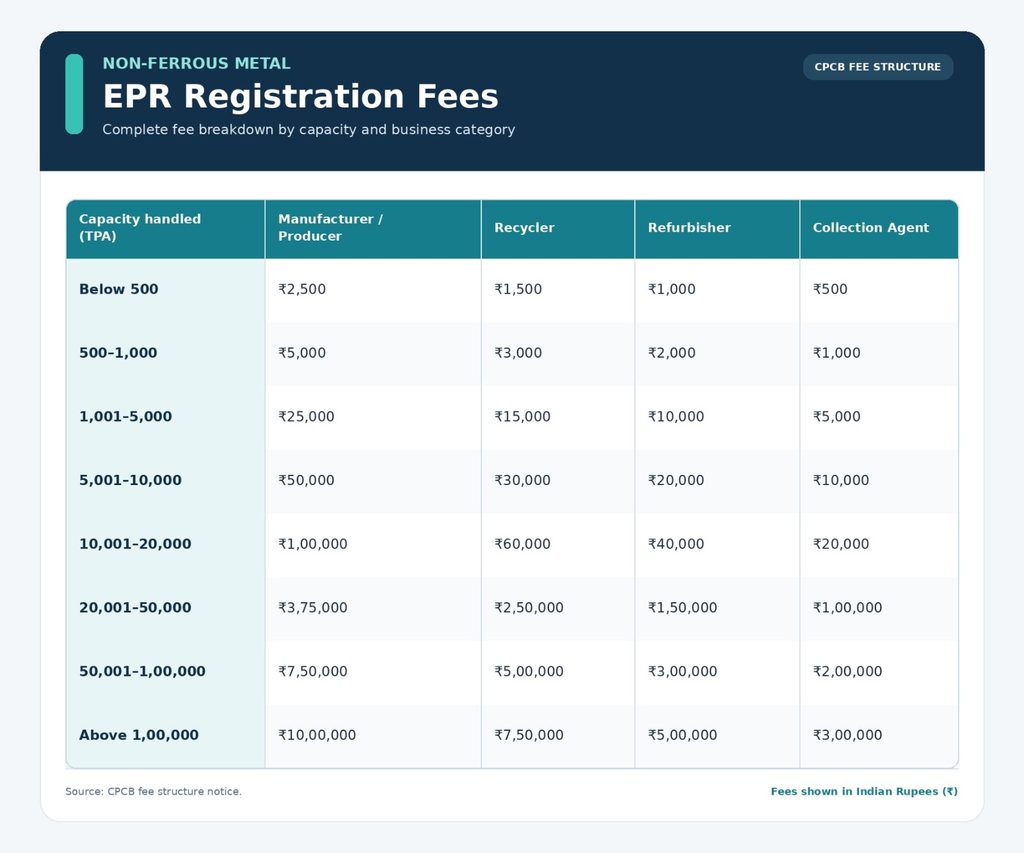
Non-Ferrous Metal EPR Registration Fees: Complete Breakdown
From registration fees to annual charges, here’s the CPCB fee breakdown your business can’t afford to overlook.
Charges PIBOs should watch out for
Once your registration is complete, a few additional charges are easy to overlook but not worth missing.
Why? Because missing these costs could complicate your compliance process and potentially expose your business to penalties.
1. Capacity Increase Amendment Fee
Has your business expanded beyond its originally registered capacity?
If so, an amendment fee of 10% of the applicable registration fee is charged for the capacity increase.
Factor this cost into your expansion plans to avoid unexpected compliance expenses.
2. Annual Compliance Fee (ACF)
Registration isn’t the only expense to plan for. An Annual Compliance Fee (ACF) is also payable when filing your annual return.
This fee covers:
- Portal maintenance
- Compliance monitoring
- Institutional and administrative costs
- Data analytics
- Audit fees
How is the Annual Compliance Fee calculated?
The fee is calculated using the following WPI-linked formula:

Source: CPCB fee structure notice.
Who is eligible for registration?
The CPCB framework identifies five categories of entities that need to register under the non-ferrous metal EPR system:
– Manufacturers
– Producers
– Collection Agents
– Refurbishers
– Recyclers
Businesses involved in manufacturing, producing, collecting, refurbishing or recycling non-ferrous metals such as aluminium, copper, zinc and their alloys should assess their applicable registration category.
One important point: If an entity operates in multiple categories, it must obtain separate registration for each applicable category.
And that’s exactly why identifying your business role correctly is essential to determining the relevant registration fee and compliance requirements.
What is the next step?
If your business entity is applicable, then these are the next steps you should prepare for:
- Identifying the applicable category: every business category has a separate fee. If your entity has multiple applicable categories, then multiple fees are applicable.
- Keep track of the amount of capacity handled: it can help you confirm the relevant capacity handling slab
- Calculate your registration fee: Once you are clear on the capacity handling slab. Calculate your applicable registration fee.
- Be updated on the annual return audit and fee: The report that you file should be based on the CPCB guidelines. The applicable Annual fee should be calculated based on the WPI-linked formula.
Knowing the fee structure is one thing. Figuring out exactly what your business needs to pay and comply with is another.
If you try to do everything yourself keep these things in mind: A wrong category, an overlooked registration requirement or an incorrectly calculated fee can complicate your compliance process.
Your problem, Our Solution
1. Unsure Which Registration Category Applies?
If your business operates across multiple roles, identifying the applicable category can get confusing. And since separate registrations and fees may apply to each category, getting this right matters.
How ARKCA helps: We help assess your business activities and identify the applicable registration requirements.
2. Not Sure Which Capacity Slab to Choose?
Your registration fee depends on the capacity handled. Misjudging your applicable slab can affect your fee calculation and registration planning.
How ARKCA helps: We assist you in understanding the relevant capacity requirements and preparing your registration accordingly.
3. Overlooking Additional Charges?
Registration fees aren’t the only costs to consider. Capacity amendment charges and the WPI-linked Annual Compliance Fee (ACF) also need attention.
How ARKCA helps: We help you understand applicable charges and plan for your compliance costs.
4. Worried About Returns and Ongoing Compliance?
Knowing when to file, what information to prepare and how to meet reporting requirements can become an ongoing challenge.
How ARKCA helps: From documentation and application filing to regulatory coordination, we support businesses through their compliance requirements.
Get Your Non-Ferrous Metal EPR Requirements Right
Don’t let fee calculations and registration uncertainties complicate your compliance journey.
Connect with ARKCA Corporate to assess your non-ferrous metal EPR registration requirements.